Industrial AI: Beyond Misconceptions to Measure Its True Environmental Impact

The rapid rise of generative Artificial Intelligence has recently brought the question of its energy cost back to the forefront of public debate. In the United States, 72% of voters are already concerned about the increasing consumption of AI-related data centers. As models develop and uses multiply, one question persistently arises: does AI consume too much energy to be compatible with climate goals?
While the question is legitimate, it most often encounters two major analytical biases that obscure AI's potential in industry to optimize resource utilization and accelerate the ecological transition. To objectively assess AI's impact in an industrial setting, it is imperative to overcome these biases.
This is precisely the subject of an unprecedented scientific study conducted by researchers from Collège de France (Mathias Abitbol, Céline Antonin, and economist Philippe Aghion, Nobel Prize in Economics 2025) in partnership with ETH Zurich (Lint Barrage), published in the Veolia Institute and Microsoft report. And the result might just surprise you.
Bias #1: The illusion of a homogeneous technology (Generative AI vs. Specialized AI & Machine Learning)
The fundamental error is to lump generative AI and industrial AI together. On one hand, large language models (LLMs) rely on billions of parameters derived from vast databases. Their training and
operation require massive infrastructures running at full capacity to generate text or images. This is a creative AI, inherently extremely energy-intensive.
"AI is often presented as a significant source of energy consumption with a major environmental impact, but this view overlooks compact and specialized systems integrated into industrial control devices." excerpt from the study
Conversely,AI applied to industrial control is a specialized AI. It relies on Machine Learning or Reinforcement Learning algorithms designed for a single task: optimizing a physical process. These models are much lighter, feed on targeted sensor data, and run on conventional servers.
As Gautier Avril, co-founder and CTO of Purecontrol, explains:
"Our technology has nothing to do with language models or generative AIs. The latter rely on probabilistic logic sometimes disconnected from physical constraints. At Purecontrol, we use reinforcement learning. The principle is similar to strategy games; the algorithm learns through iterations, by trial and error, to optimize its decisions in a constrained environment." - Gautier Avril
Bias #2: Analyzing consumption without considering the savings generated
The second pitfall is to evaluate AI's energy impact in isolation. Public debate often focuses on the raw consumption of servers, overlooking the emissions avoided in the physical world. To be fair, the environmental analysis of a digital tool must be systemic. If a server consumes a tiny amount of energy but enables a hundred times more savings in the operation of an industrial facility, the carbon footprint is overwhelmingly positive.
“No rigorous evaluation has yet been conducted to measure the overall energy cost and/or net energy benefits of AI” excerpt from the study
In industry, the potential for savings is colossal because, without dynamic control tools, machines are often configured with conservative thresholds to ensure safety margins. AI applied to industrial control acts as the "brain" of energy efficiency: it consumes only a tiny amount of energy to decide when and how to save megawatts at the factory level. The real question, therefore, is that of net gain.
Real-world evidence: the study by Collège de France and Veolia
This is precisely what the Collège de France study measured by analyzing the large-scale deployment carried out by Veolia. In partnership with Purecontrol, the group implemented a cutting-edge AI solution (combining Machine Learning, reinforcement learning, and digital twin technology) at the heart of 200 wastewater treatment plants to maximize their climate efficiency.
Wastewater treatment is a particularly relevant sector, as basin aeration during secondary treatment (an essential step that provides oxygen to microorganisms to break down pollution) alone accounts for about half of a plant's electricity bill.
Purecontrol's AI changes the game by modeling a virtual replica (digital twin) of the aeration process through high-frequency analysis of data from heterogeneous sources :
- internal sensors: water flow, probe values, electrical power
- laboratory analyses (regulatory quality indicators)
- weather forecasts
- electricity market: electricity prices on the markets, grid demand charges
The algorithm then predictively plans and regulates aeration to minimize consumption and cost while respecting regulatory water quality thresholds. Human intervention remains central: operators retain full control and can take over at any time.

Unequivocal results: 1% cost for 10% savings
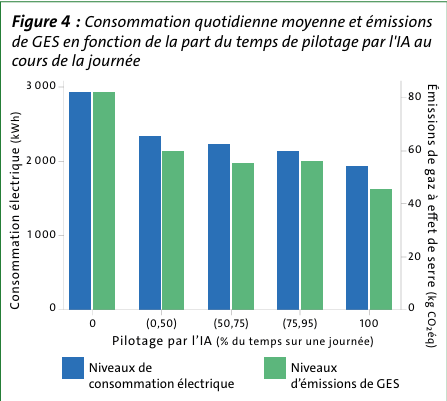
““a nearly 10% reduction in electricity consumption and greenhouse gas (GHG) emissions, while the direct electricity consumption of AI represents less than 1% of the gross energy savings achieved.” excerpt from the study
The preliminary results of the study (measured on an initial representative sample of plants) demonstrate an extremely robust net climate benefit:
- 10% energy and CO₂ savings: On days when AI is fully active, an average reduction of nearly 10% in the facility's overall electricity consumption and associated greenhouse gas (GHG) emissions is observed.
- Less than 1% overhead: The direct electricity consumption of the servers dedicated to running Purecontrol's AI layer represents less than 1% of the gross energy savings achieved.
- A positive Life Cycle Assessment (LCA): Even when adopting the most conservative and pessimistic scenarios — including the carbon footprint associated with the manufacturing and delivery of new on-site hardware equipment — the total carbon cost over the entire AI lifecycle never exceeds 30 to 45% of the emissions avoided. The net carbon benefit therefore remains largely positive.
- Valuable flexibility for the electricity grid: Purecontrol technology also has the ability to intelligently and in real-time shift part of the aeration cycles to times when national electricity is least carbon-intensive or to avoid periods of strain on the electricity grid (demand response).
The study by Collège de France and Veolia thus shows that targeted industrial AI is not a futuristic concept, but a concrete and immediately deployable decarbonization tool. At a time of decisive choices for the climate, industry possesses, with control AI, a powerful lever to reconcile operational performance and energy moderation.