Reducing N2O emissions in WWTPs: how predictive AI solves the aeration equation

Nitrous oxide (N2O) is the blind spot of wastewater treatment's ecological transition: 300 times more warming than CO2, it accounts for up to 80% of a WWTP's direct carbon footprint. With the introduction of UWWD 2, WWTPs serving over 10,000 PE must reduce their greenhouse gas emissions, and therefore N2O, but face an operational complexity that seems insurmountable:
How can one reconcile strict effluent quality requirements, optimization of operating costs, and the reduction of highly volatile gas emissions, all while having limited experience with measurement? Is it necessary to invest heavily in sensors to hope to model this complexity? And once measured, how can this constraint be integrated into the aeration strategy?
While the task seems complex, Rennes Métropole's pioneering deployment shows it's possible. Rennes Métropole and Purecontrol have deployed the first real-time control system in France aimed at reducing nitrous oxide (N₂O) emissions. Results: 375 kg of CO2 equivalent avoided per day
1. UWWD 2 and SNBC: A regulatory framework for reducing N emissions2O
The wastewater treatment sector is undergoing a profound transformation. Until now, the performance of a wastewater treatment plant was measured by the quality of its effluent. Now, a new metric is emerging: the carbon footprint.
This change is driven by two major regulatory pillars:
- The revision of UWWD 2 . The ambition is clear: to achieve climate neutrality in the wastewater treatment sector*. The European directive explicitly identifies the reduction and monitoring of greenhouse gases as an obligation for local authorities.
- The National Low Carbon Strategy (SNBC). This is France's roadmap for combating climate change. It sets very concrete reduction targets: the waste and sanitation sector must reduce its emissions by 37% by 2030.
To meet these requirements, tackling CO2 alone will not be enough. The main lever lies in the nitrous oxide emitted during aeration cycles in treatment basins. With a warming potential 300 times greater than CO2, N2O often represents the bulk of a plant's carbon footprint.
In Europe, several countries have already taken action: the Netherlands is implementing an acceleration program to mandate the deployment of continuous N2O measurement sensors at approximately 60 major wastewater treatment plants in the country; in Denmark, parliament is imposing regulations aimed at reducing N2O emissions by 50% for wastewater treatment plants serving more than 30,000 population equivalents; in the United Kingdom, the "Net Zero 2030 Roadmap" aims for carbon neutrality as early as 2030, specifying a reduction of up to 60% in process emissions.
As highlighted by Boris Gueguen, Sanitation Director of Rennes Métropole, during his conference at the last Water Crossroads event :
"Within our specific wastewater treatment scope, we have energy objectives that also underpin greenhouse gas objectives. Article 1 of the UWWD clearly identifies the reduction of greenhouse gas emissions as an objective. We are required to monitor and measure them. We realize that to achieve these objectives, we must address N2O."
The world of wastewater treatment has taken on a new dimension. Once considered secondary, N₂O emissions are now central to all roadmaps. Given the trajectories of the SNBC and UWWD 2, the time for theoretical estimations is over; it's time for the deployment of breakthrough technologies. Optimizing nitrogen treatment through intelligent regulation has become the priority lever for making water management a model of circular and decarbonized economy.
*Monitoring of GHGs (CO2, N2O, and CH4) emitted by WWTPs >10,000 PE)
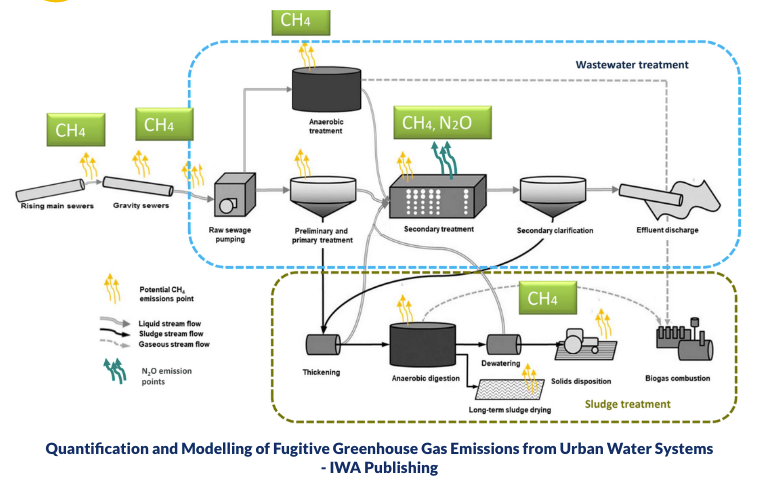
2. The Biology of N2O: Volatile Emissions Difficult to Anticipate
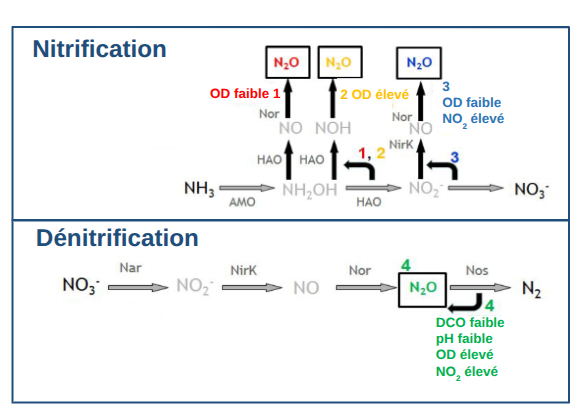
To understand why reducing nitrous oxide emissions presents a significant modeling challenge, one must delve into the biology of wastewater treatment. N2O is an extremely volatile gas, generated during the two key phases of nitrogen treatment:
- During the nitrification phase (with aeration): During this step, bacteria convert ammonia into nitrates. However, if these bacteria experience stress (such as a drop in oxygen or a sudden, massive influx of pollution), their metabolism malfunctions. To survive, they take "emergency pathways" that release N2O as an undesirable byproduct.
- During the denitrification phase (without aeration): Here, bacteria convert nitrates into harmless nitrogen gas. To achieve this, the molecule is degraded step by step, and one of these intermediate steps is precisely N2O. It is therefore an unavoidable chemical transition phase.
As explained by Damien Leduc, an engineer at Purecontrol: "Regardless, we will go through the nitrous oxide stage before moving to the nitrogen gas stage."
The major risk for the operator lies in air management. The N2O produced during the denitrification phase remains dissolved in the water. If aeration restarts inappropriately, the air bubbles injected into the basin will act like an elevator, extracting this N2O and abruptly releasing it into the atmosphere.
The operator is thus faced with a multidimensional challenge. They must juggle in real-time between:
- maintaining impeccable water quality,
- avoiding skyrocketing operating costs,
- avoid erratic and sudden N2O peaks.
An equation that is almost impossible to solve and anticipate with a conventional automation system.
3. AI-driven predictive control: transforming existing data to anticipate N emissions2O
The traditional response to this type of problem often involves measuring pollution by installing continuous physical sensors in the basins. While this measurement is useful for establishing an overall assessment, it quickly proves limited given the volatility of N2O: probes are expensive, require heavy maintenance, and above all, they are reactive. They measure the gas once it has already formed.
The real technological breakthrough lies in the ability to process all cross-referenced data (incoming load, quality, costs, biology) to intelligently control the facility and prevent the formation of nitrous oxide.
To achieve this, the first step is to precisely characterize the behavior of the aeration cycles at the treatment plant. This is where the expertise of N₂O emissions specialists from wastewater treatment processes, such as Cobalt Water Global, comes into play, to conduct field measurement campaigns and advanced modeling. This phase allows for understanding the plant's specific N2O "signature".
Once this reference modeling is acquired, Purecontrol will take it into account in the dynamic regulation of the aeration strategy. Purecontrol's algorithm continuously ingests a multitude of signals (flow rates, ammonium concentrations, dissolved oxygen, Redox potential...) to decipher the biological state of the basin in real time, and will also take into account the N2O emissions modeling performed by Cobalt Water.
Control then becomes proactive: faced with the complexity of variables, the software intelligence cross-references data to anticipate bacterial stress conditions or degassing risks. It instantly translates these analyses into ultra-precise instructions sent to the blowers. By adjusting aeration minute by minute, the algorithm maintains biology within a stable zone, taming N2O volatility while ensuring treatment compliance.
Damien Leduc: "Purecontrol will integrate the N2O emissions model into our decision-making frameworks, to enable decision-making that incorporates aeration costs as well as nitrous oxide emissions."
4. Rennes Métropole: Data intelligence supporting political decision-making
Initially deployed at the Beaurade wastewater treatment plant (360,000 PE), the solution was then implemented at the Betton (40,000 PE) and Saint-Erblon (50,000 PE) plants to regulate aeration while simultaneously managing this triple constraint: compliance, operational costs, and N2O reduction.
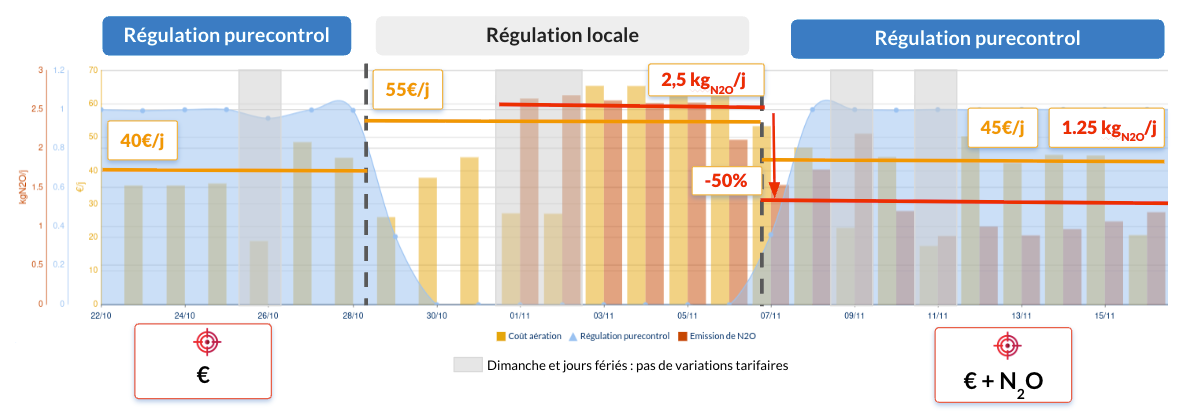
At the St Erblon wastewater treatment plant (50,000 PE), the results demonstrate the power of predictive modeling:
- 1.25 kg of N2O avoided per day.
- Representing a reduction of approximately 50% of N2O emissions from the instrumented line.
- This represents -375 kg of CO2 equivalent avoided daily.
To give you an idea of the scale: the carbon impact avoided corresponds to 12,500 kWh of electricity per day, which is three times the station's total electricity consumption.
However, tackling this complex equation reveals an operational reality: to optimally block volatile N2O emissions, aeration cycles sometimes need to be adjusted with surgical precision, which can lead to slight variations in the electricity bill.
This is where technology serves strategic decisions for local authorities. The algorithm allows them to no longer be dictated by data, but to set the "slider" of this multidimensional balance to align with the objectives set by the local authority and the sanitation department. Rennes Métropole has committed to reducing greenhouse gas emissions by 50% by 2030, so, to reduce these emissions while limiting the additional energy cost, a maximum energy consumption tolerance of +10% has been integrated into the model.
For Boris Gueguen, technical complexity then gives way to a clear public policy decision:
“The ball is in the court of Rennes Métropole's elected officials: what policy do they intend to pursue? What amount do they want to allocate to this fight against nitrous oxide emissions? And that's truly a political choice. One of the solution's advantages is that it takes your choices as input, applies them, and helps you achieve your objectives through successive learning."