AI-driven industrial control: turning data into real-time action



[Article written as part of a publication with Interface Magazine - INSA Alumni]
With Industry 4.0, industrial facilities have massively scaled up their data generation. Today, AI makes analyzing this data increasingly accessible. Yet a major challenge remains: moving from measurement to action. Where many solutions stop at dashboards or recommendations, Purecontrol goes a step further. Our algorithms apply setpoints in real time and continuously balance multiple goals and constraints, turning industrial data into a powerful lever for energy, environmental, and operational performance.
For a long time, the main challenge for industrial players was equipping their facilities with instrumentation. Today, this is standard on most sites: flow meters, sensors, PLCs, and supervisory systems are part of the landscape. Factories now produce data continuously. Yet, most of these measurements feed into charts that are rarely consulted or utilized. This is the paradox: our processes have never been more measured, and the gap between what we know and what we do with it has never been wider.
A key question arises: how can we move from data to real-time facility control without compromising safety, while also bringing the operational teams on board?
Collecting and securing industrial data
Driven by Industry 4.0, online instrumentation has become widespread in factories. Connected to local PLCs, most of these sensors are simply displayed on a supervisory screen. This step, which may seem trivial, raises issues of connectivity (Modbus, Profinet, OPC UA, etc.) and cybersecurity. These foundations can also integrate external data from third parties (demand response, weather, energy prices). Leveraging these sensors is essential: without concrete use, they provide no return on investment and eventually stop being maintained.

Predictive regulation: a new way to control processes
Once validated, this historical data forms particularly rich multivariate time series that can be leveraged both to detect anomalies and to improve facility efficiency.
The aeration basin of a wastewater treatment plant is a prime example. The goal here is to regulate the oxygen supply required for water treatment. The blowers providing this aeration account for more than half of the plant’s entire electricity bill. Traditionally, a reactive PID controller maintains a fixed oxygen setpoint. When a heavy load arrives abruptly (after a storm, for instance), the controller only responds after the fact, risking effluent non-compliance. That is why plant operators typically keep an extra safety margin to ensure discharge standards are met.
To address these challenges, digital twin approaches have grown in popularity. In our scenario, however, they require modeling sludge biology, continually adjusting numerous parameters that fluctuate with temperature and effluent conditions, and deploying a large number of sensors to calibrate the twin. While feasible for a flagship showcase site, a digital twin is difficult to replicate from one facility to another, making large-scale deployment cost-prohibitive in terms of both expertise and sensor hardware.
Conversely, a model learned entirely from historical data using modern machine learning techniques requires no modeling and adapts to existing sensors. However, the collected data only shows the basin under its usual regulation. The model knows how to detect a drift, but not how to predict the effect of a different setpoint. It remains limited to alerts and recommendations.
New approaches combine the best of both worlds: a model trained on real-world data, yet guided by domain knowledge of the process. Lightweight enough to be deployed anywhere, reliable enough for autonomous control. Leveraging centralized data collection systems, it factors in rain forecasts and upcoming electricity prices. Model predictive control built on this framework anticipates aeration needs before peak loads arrive, scales back when conditions allow, and optimizes energy consumption by prioritizing off-peak hours.
Long reserved for industrial players with significant R&D budgets, these advanced control systems can now be deployed at a low cost. They also remain frugal, thanks to a model specialized for each process rather than a massive, general-purpose model with a high digital footprint.
Change management: the key to successful AI-driven control
In the industry, control remains overwhelmingly reactive: thresholds, fixed setpoints, and PID loops. These regulations have proven their worth, but they are often limited to a single output, do not incorporate optimal operating points, and correct disturbances after the fact. Operators must then build in a safety margin for business constraints, at the expense of performance.
A data-driven model, such as the one described above, instead makes it possible to anticipate needs and optimize the process. The principle is to run this module directly in a closed loop, without requiring human validation for every setpoint. A simple recommendation engine risks being overlooked by operational teams, whereas autonomous control ensures the value generated by data collection is actually realized.
However, this mode of operation requires tailored change management. The predictive approach (anticipating constraints and requirements), combined with multi-variable control, can initially be difficult to grasp. Successful deployment therefore depends on the explainability of the solution.
Take the wastewater treatment plant again: excessive aeration might seem counterintuitive to an operator. By making upcoming pollution forecasts visible, automated scheduling clearly explains control decisions and fosters team buy-in on site. This buy-in is all the stronger because this new control method frees operators from low-level reactive monitoring. Instead of focusing on dissolved oxygen levels, they can define target constraints for final water quality.
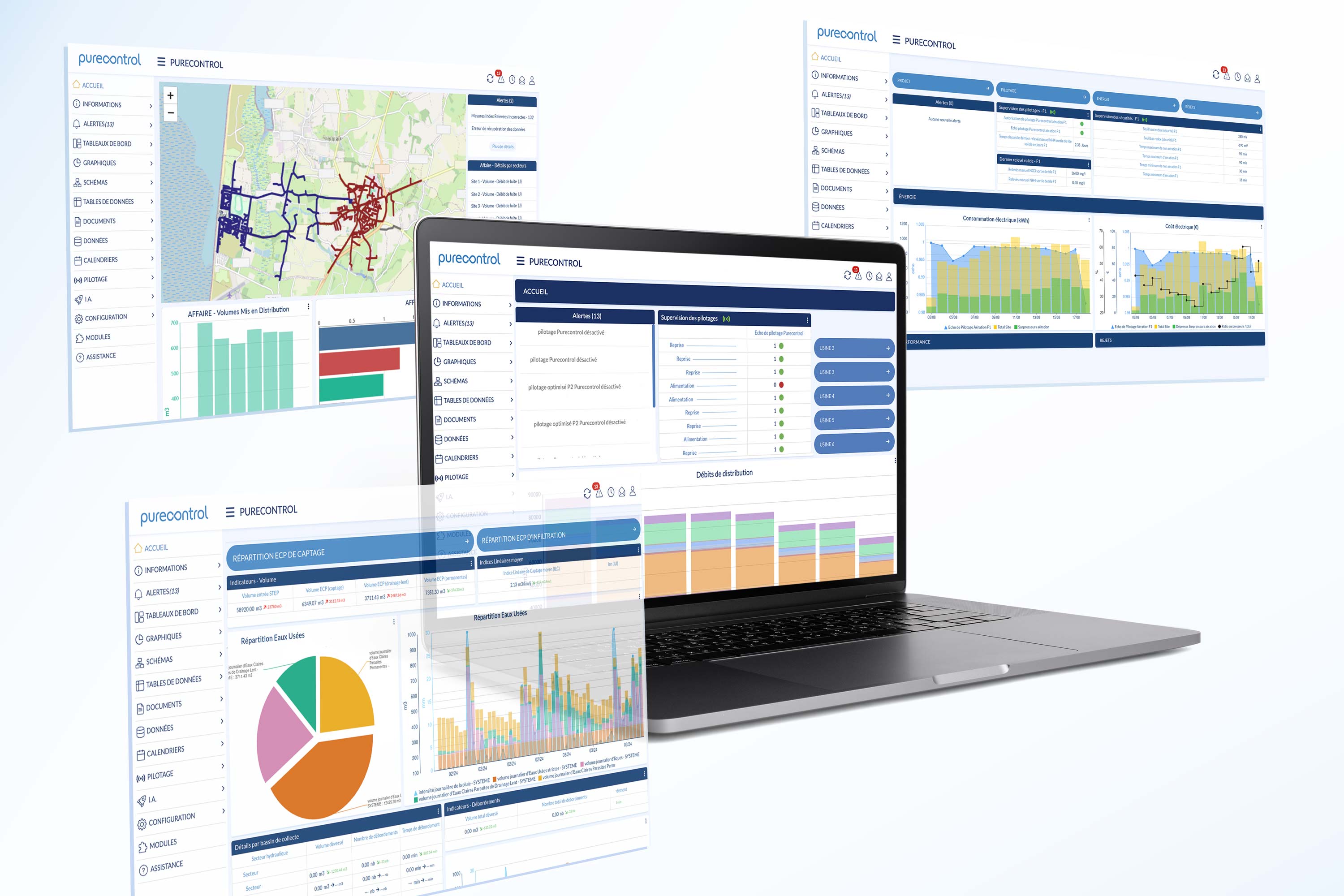
At Purecontrol, we deploy these advanced algorithms remotely, training teams on the tool and collaborating closely with clients to translate their high-level objectives into AI-driven solutions. Through integration with PLC supervisory systems and accessible configuration settings, operators retain full control over their facility by adjusting high-level operational constraints (defined in process terms rather than PLC code). Safety is still guaranteed at the PLC level: should communication with our servers drop, the PLC automatically falls back to local control using the facility's standard settings.
Case studies: from wastewater treatment plants to milk powder production
Our algorithms are agnostic and apply to all industrial sectors. We have achieved compelling results across varied use cases, from the water sector to food processing and waste recovery. Whether dealing with major disturbances, strict standards, or the need for energy flexibility, the paradigm remains the same. Over 600 sites are now managed by these AI algorithms, which are capable of adapting to the diversity of installations.
For example, we provide end-to-end control for milk powder production, from the evaporator to the spray drying tower. Centralized PLC integration, data-driven modeling, and global optimization allow the entire line to run right up to the limiting factor of its slowest link. The spray drying tower, which accounts for nearly half of the facility's energy consumption, requires multivariable control to handle variations in raw materials and ambient air conditions. Data-driven control enables the plant to operate as close to its physical limits as possible while consistently guaranteeing product quality.
These performance and efficiency gains are confirmed in the field and documented by independent studies. For activated sludge wastewater treatment plants, Philippe Aghion (Collège de France) and his co-authors [1] studied the impact of this solution in a study published in February 2026 by the Veolia Institute. They observed a nearly 10% reduction in electricity consumption and associated emissions on days when the AI fully controlled the aeration. The energy cost of the AI solution represents less than 1% of the gross energy savings achieved.
[1] ABITBOL, Mathias, AGHION, Philippe, ANTONIN, Céline and BARRAGE, Lint, 2026. How can AI contribute to energy efficiency goals in the industry? Veolia Institute Review, FACTS Reports: Artificial intelligence for energy, water, and waste. Veolia Institute and Microsoft.