Optimizing Milk Drying: Mastering Energy and Moisture
.webp)
In the agri-food industry, and particularly in the dairy sector, spray drying is a key processing step. This process, which converts complex liquids (milk, whey, flavors, proteins, infant nutrition) into solid powders, addresses fundamental challenges: it ensures the bacteriological stability of products, facilitates their storage, extends their shelf life, and reduces logistical transport costs.
However, this essential operation presents a significant industrial challenge: it is particularly energy-intensive. In a dairy processing plant, drying towers alone can account for up to 25% of the site's total energy consumption. At a time when the industry must combine process decarbonization, adherence to strict environmental standards, and maintaining competitiveness in the face of volatile energy costs, optimizing atomization is now a strategic priority.
1. Spray Drying: A Highly Complex Thermal and Operational Balance
The theoretical principle of spray drying is well known: it involves spraying a liquid (previously concentrated) into a mist of very fine droplets inside a drying chamber. These droplets then come into contact with a powerful flow of hot air (often gas-heated). The water evaporates almost instantaneously, leaving solid particles that are collected at the bottom of the tower.
However, the industrial operation of a drying tower requires mastering numerous variables. Historically, the regulation of these installations has largely relied on empirical know-how and operator experience. The process often operates reactively, making it sensitive to multiple factors:
- Raw material variability: The characteristics of the incoming liquid (dry matter content, viscosity, temperature) fluctuate depending on production batches.
- Exogenous and meteorological conditions: The air used to dry the product is drawn from outside. Thus, ambient humidity varies in real-time and impacts the tower's drying capacity. Operation is therefore closely dependent on its meteorological environment.
Faced with these uncertainties, reactive operation has certain limitations. The main operational risk is "clogging": if the powder is too wet, it adheres to the tower walls, causing blockages that necessitate stopping production for cleaning, which requires time and resources. To prevent this risk, operators naturally tend to apply a safety margin by heating the air more than necessary, to compensate for raw material and weather variability. This "over-drying" ensures compliant powder and limits shutdowns, but leads to significant energy overconsumption and impacts economic efficiency.
2. From Reactive to Predictive Control of Drying Towers
To evolve this thermal approach, the industry has the opportunity to shift towards anticipation. Thanks to current technologies and data analysis, it is now possible to move from reactive control to predictive and dynamic regulation.
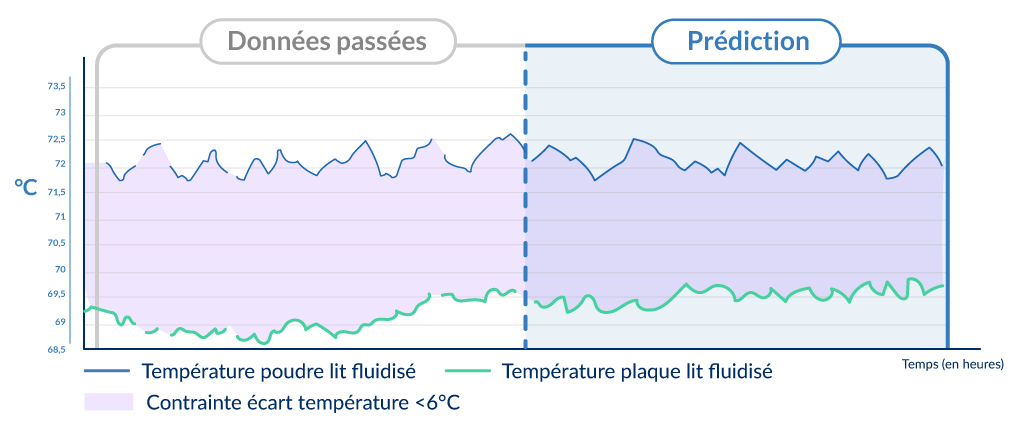
This is precisely the technological approach developed by Purecontrol. The solution is based on creating a digital twin of the drying tower. Specifically, the system continuously analyzes data from the plant's PLCs (milk inlet flow, air inlet and outlet temperatures, dry matter content) and instantly cross-references it with external data streams, such as local weather forecasts and anticipated ambient humidity.
This precise thermodynamic modeling offers a predictive view: the system can anticipate changes in powder moisture content and thermal deviations with a visibility ranging from +6h to +12h. Instead of reacting to a disturbance (for example, the arrival of a very humid air mass), the solution automatically and smoothly adjusts the tower's parameters even before the meteorological event impacts the production line.
3. Energy Efficiency and Yields: The Benefits of Dynamic Regulation
Integrating such a software solution into the core of drying processes tangibly improves the performance of industrial sites. The results of this predictive control are concretely measured at several levels:
- Optimized and controlled energy efficiency: By continuously calculating and applying critical setpoints (precise adjustment of hot air flow and inlet/outlet temperatures), the system limits the need for overdrying. The thermal energy consumed corresponds to the evaporation capacity required at any given moment. Reductions in gas and electricity consumption are sustainable.
- Increased productivity: Thanks to precise modeling, the system adjusts performance in real time to achieve optimal efficiency while respecting the technical limits of the installation.
- Process security and increased yields: By smoothing out variations, the powder's moisture content becomes more stable and homogeneous. The risks of deviations leading to non-compliant products and the threats of blockages are significantly reduced. Furthermore, by getting as close as possible to the maximum allowed moisture target without exceeding it, the manufacturer optimizes their product tonnage (improving material yield).
- Valuing human expertise: Advanced control solutions, such as those offered by Purecontrol, integrate hypervision tools that allow teams to monitor performance indicators in real time. This provides a valuable decision-making tool that supports the lasting transmission of complex industrial know-how, such as drying.
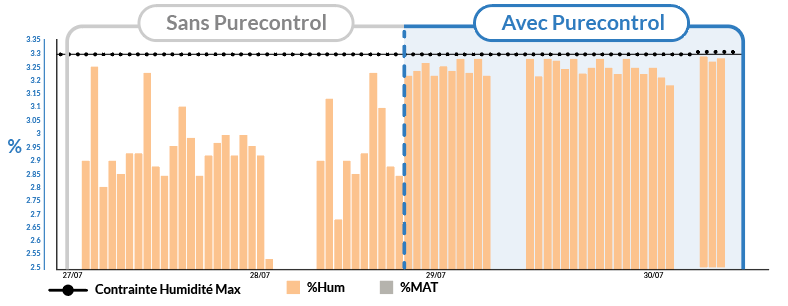
Optimizing spray drying illustrates the value of digital transformation in industrial processes. Dynamic and predictive control does not replace the essential expertise of production teams; it complements it. By equipping food industry manufacturers with tools capable of analyzing and anticipating multiple variables in real time, it is possible to combine impeccable powder quality, maximized yields, and a reduced environmental and energy footprint.