Energy performance of refrigeration: 5 questions to Ewen Maguer about AI regulation

Is industrial refrigeration the last blind spot in industry's energy strategy?
In most factories, refrigeration is managed as a convenience: as long as the instructions are respected and the alarms do not sound, nothing is touched. But that comfort comes at a price, and it's becoming exorbitant. With the end of ARENH which now exposes your energy budgets to the volatility of the free market, maintaining static settings is no longer a simple management habit, it's a profitability leak.
Is it possible to juggle prices per MWh without jeopardizing product quality? And above all, how do you inject intelligence into an installation that was not designed for this?
To understand how predictive AI is transforming your cold storage equipment into flexible assets, we asked Ewen Maguer, Industry Product Manager at Purecontrol around a straightforward exchange to transform your kilowatts into profitability levers.
1. Why has refrigeration management become a priority financial issue for manufacturers?
Ewen Maguer: Because it is a massive expense item that comes out of its comfort zone abruptly. Refrigeration accounts for around 4% of national electricity consumption and can weigh up to 50% of the energy bill of an agri-food site (Source: ADEME).
Until recently,Protected rates and ARENH masked regulatory inefficiencies. But since January 1, 2026, the rules have changed: manufacturers are now in direct contact with the free market. Producing cold at 6 pm when the price per MWh soars, when you could postpone this load, is literally burning your net margin. Regulation is no longer a technical option, it is an accounting necessity.
2. Concretely, how does Purecontrol's AI manage to boost refrigeration energy efficiency without major investments?
E.M.: First thing you need to know: we're not asking you to replace your compressors. In reality, they are given a brain. Our operation is based on a regulation loop in three steps:
- Data collection
We are not adding physical sensors. We connect directly to your existing controllers via standard industrial protocols to recover the data that is already sleeping in your machines. - Learning and analysis:
The AI analyzes your thermal signature, the impact of the weather, dry or humid temperature, and your production cycles to create a digital twin of your site. - Predictive management:
Once the model is ready, the AI anticipates. Every minute, it sends an optimized instruction to your automaton. Instead of reacting when the temperature rises, it acts beforehand so that the machine works at the best time.
3. What is the advantage of adopting a “Block + Spot” energy contract and how can you control it?
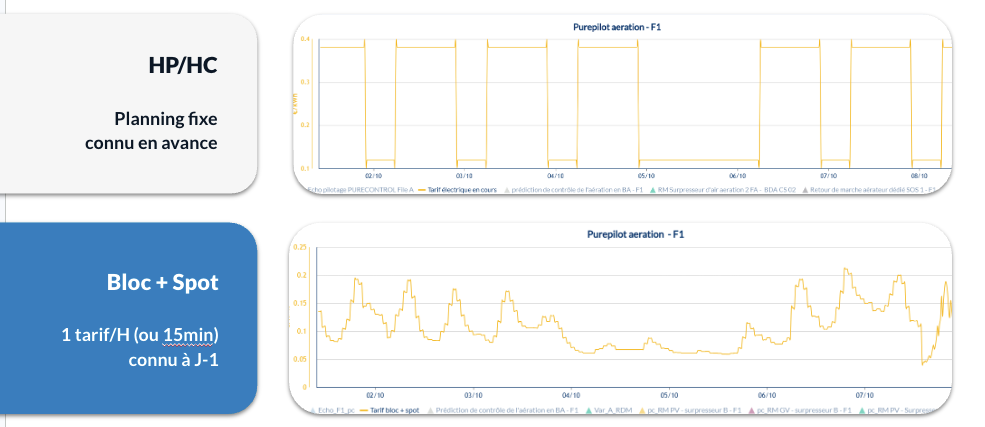
E.M.: Today, it is the number one lever for transforming an expense incurred into a financial opportunity. To fully understand, you have to look at the evolution of energy contracts: manufacturers are increasingly abandoning 100% fixed tariffs for “Block + Spot”. It is a hybrid strategy where you secure an electricity base at a fixed price, the Block, while completing the rest at the market price in real time, the Spot.
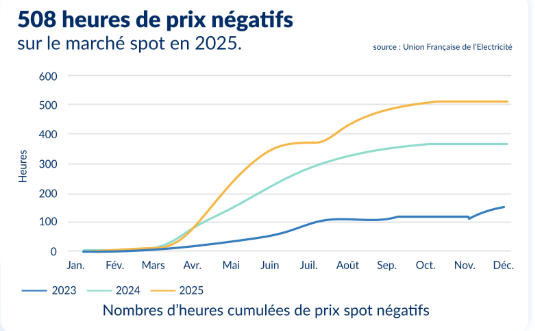
The whole challenge of flexibility lies there: the Spot market is seeing more and more frequent emergence of negative prices. During peaks in renewable energy production, to stabilize the electrical network, electricity sometimes becomes free, or even profitable for those who consume. Cold rooms are actually giant reservoirs of thermal energy. The idea is to use this inertia to “charge” cold at the precise moment when energy is abundant, in order to reduce demand when prices saturate.
This is where AI becomes indispensable, because in this market, The price changes every hour or every 15 min. A human operator cannot manually adjust the temperature settings of the equipment according to the energy market prices continuously. Purecontrol therefore acts as an automated conductor who anticipates prices the day before and adjusts the instructions every minute. In this way, we make sure to take advantage of low price windows to store cold, while staying in the fixed “Block” as much as possible during price peaks. For a customer like Solarenn, this agility transforms a storage constraint into a real financial asset: we no longer suffer from market volatility, we exploit it.
4. Concretely, what are the gains observed on the ground?
E.M.: Across all of our controlled industrial sites, we are seeing a average reduction of 5 to 15% in energy consumption depending on the average outside temperature, and from 10 to 30% on the bill, depending on the price contract.
To illustrate this with a concrete case, the cooperative Solarenn is a great example. By applying our dynamic regulation to their refrigeration units, they have obtained major results:
- > 20% reduction in energy bills over the managed perimeter
- A real saving of 100 to 400 kWh every day.
- A new capacity to absorb market price peaks without any impact on the quality of their production.
What to remember, It is because these performances are not reserved for the vegetable sector. Whether you manage logistics warehouses, freezing tunnels or chemical cooling processes, the lever remains the same: transform an inert installation into a predictive system. Since we optimize what already exists, the return on investment is almost immediate.
5. Entrusting instructions to an AI may seem like a big leap. How do field teams keep control of the production tool?
E.M.: Business constraints and safety temperatures are set in the stone of the local automaton. AI does not replace your security, it is subject to it.
If the algorithm proposes an instruction that goes beyond the limits set by your refrigeration engineers, the automaton rejects it instantly and takes control again. We call it regulation “under supervision” : AI manages the complexity of data to optimize performance, but the process remains protected. This frees up a huge mental load for teams without ever compromising product safety. For those who want to delve into the aspects of network protection, In fact, I refer you to Gautier Avril's blog on industrial cybersecurity.
What you need to remember: turning your kilowatts into profitability levers
2026 marks the end of predictable energy prices. Faced with price volatility, the status quo has become a daily opportunity cost. The profitability of your site now depends on your ability to transform the consumption experienced into a dynamic flexibility lever.
In addition to price optimization, The AI also allows you to activate the erasure of consumption : by modulating the power of your chillers during voltage spikes, you receive bonuses from the network manager. You are no longer content with saving, you are paid for your agility.
You already have the machines and the data. All that's needed is predictive intelligence to turn your storage constraints into profit. Finally, take back control of your first item of expenditure.